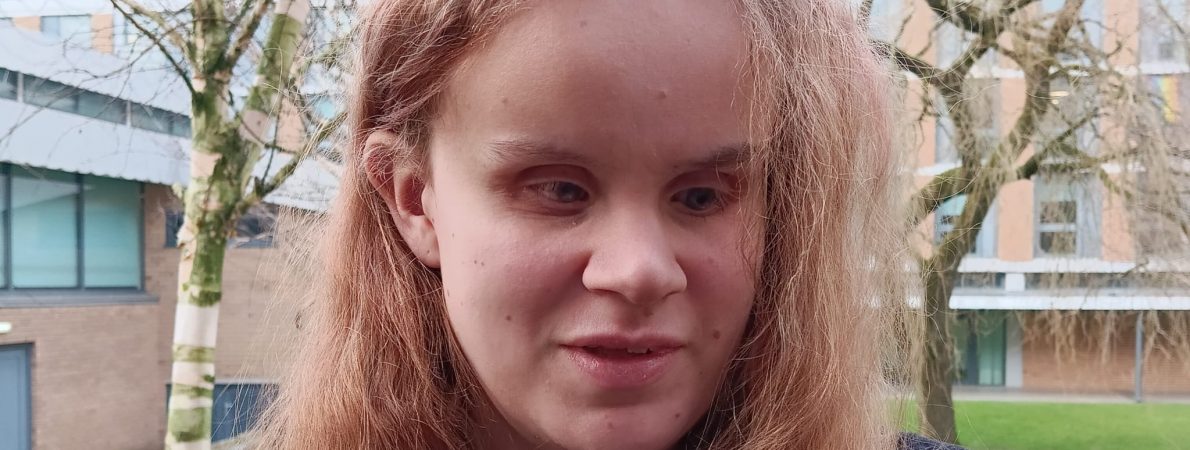
Martha’s story: Why universities must do better for blind and partially sighted students
“I had to fight every single day just to access my education.”
Martha is a postgraduate scriptwriting student at Bournemouth University. She previously studied Theatre and Creative Writing at Lancaster University, where she was the first blind student on her programme. Across both degrees, she has faced significant barriers to accessing her education. Barriers that no student should have to overcome alone.
Her experiences highlight the urgent need for universities to take responsibility for accessibility, and for Disabled Students’ Allowance (DSA) to better meet the needs of blind and partially sighted students.
Growing Up and Entering Higher Education
Martha is severely sight impaired due to childhood bilateral retinoblastoma. She has no vision in her left eye and inconsistent light perception in her right. She attended New College Worcester from age 11 to 19, where she gained her GCSEs, A levels and music diploma.
When she moved into higher education, she quickly realised she would be the first blind student her departments had ever taught, both at undergraduate and postgraduate level.
“It’s like having to do multiple jobs on top of being a student… an advocate, an educator, an IT specialist, a problem solver. You have to do all the emotional labour just to access anything.”
The DSA Process
Martha has been through two DSA assessments. Both times, she found the system difficult to navigate.
‘If you don’t know what to ask for, you won’t get it’
She observes that that unless a student already knows exactly what equipment and support to request, it is unlikely to be offered.
“If you don’t know, you don’t get. And often the assessor doesn’t know either.”
As a result, Martha received support for dyslexia and wellbeing but no specialist vision impairment (VI) support throughout her entire undergraduate degree. She had to teach staff how to make materials accessible, negotiate adjustments herself, and act as the link between the disability service and her academic departments.
Technology Delays and Incorrect Support
Even when DSA equipment was approved, accessing it was a struggle. She described month long delays, being assigned the wrong type of tech support, and trainers who did not understand how to work with blind students.
“I was almost having to teach him how to teach me.”
Mobility Support: ‘Dead Zones’ and Unsafe Guiding
Martha also faced major challenges accessing mobility training through DSA. In both Lancaster and Bournemouth, there were no local mobility officers available.
One mobility trainer had to travel from Surrey to Lancaster for occasional weekend sessions. Her current mobility officer travels from Brighton to Bournemouth.
Sighted guiding support was even more inconsistent. Many guides were untrained students who had applied for note‑taking roles but were assigned guiding instead.
“Some had watched a couple of YouTube videos. Others turned up late or cancelled the night before. I often didn’t feel safe.”
She also experienced inappropriate physical contact from untrained staff attempting to guide her.
Barriers Within University: Inaccessible Teaching and Discriminatory Experiences
Across both degrees, Martha repeatedly encountered inaccessible teaching practices, a lack of staff training, and at times, discriminatory behaviour.
Inaccessible Lectures and Materials
At Lancaster, she regularly attended lectures where no adaptations had been made.
“I went into a lecture on poetry through photography. They showed images for the whole session. Nothing was accessible. It was a compulsory lecture, and when I spoke to my module convener/leader about it to flag it up later, I was told that the lecturer probably didn’t understand.”
Audio description was rarely provided for theatre recordings, despite being essential for her course.
Martha acknowledges that she has received some excellent support during her time at university, but she feels this has depended entirely on the goodwill of individual staff members. She hasn’t seen any real accountability when staff are unwilling to make reasonable adjustments, nor any system ensuring they have the training or support needed to do better.
“I have had some really amazing tutors and lecturers who have gone out of their way to support me, but that has been their individual choice to do as educators which hasn’t been supported by the wider University.”
Public Singling Out
Several lecturers publicly announced her blindness to entire classes, framing her as someone who “needed help”.
“I don’t need a public announcement. It’s physically painful.”
Postgraduate Exclusion
Martha’s postgraduate experience revealed how deeply inaccessible teaching can exclude blind students from learning.
One module on her course relied heavily on visual clips, yet instead of adapting the materials, Martha was asked to memorise a significant and unreasonable number of clips in advance.
Rather than ensuring the accessibility of lecture materials to meet her needs, the university told her she could either attend without accommodations or be taught separately. She was then removed from the class for the rest of the semester.
At the same time, another module failed to provide audio description for almost three months, leaving her unable to access core content.
“I didn’t receive any audio description until the 5th of December. That was the whole semester.”
The lack of accessible teaching isolated her from her cohort, undermined her learning, and placed enormous strain on her mental health. Only when she reached crisis point did the university begin to act.
The Emotional Toll
The constant advocacy, isolation, and lack of support had a profound impact on Martha’s mental health.
“It felt like a fulltime job just fighting for basic access. I lost confidence in myself and in my future.”
Despite this, she continues to push for change not just for herself, but for future blind students.
What Has Helped
Martha speaks highly of the specialist VI support she finally received during her master’s, particularly from her DSA funded Specialist Support Professional (SSPVI).
“[my SSPVI] has been amazing. Having someone who understands visual impairment has made such a difference.”
She also draws strength from the blind creative community and projects like Brailled It, which show what accessible arts education could look like.
What Needs to Change
Martha believes universities must take responsibility for accessibility, rather than leaving it to students to fight for.
- Mandatory staff training: From lecturers to disability advisors to sighted guides, staff need training in vision impairment awareness, accessible teaching, sighted guiding, inclusive communication and safeguarding.
“My disability advisor told me they had no resources and no idea how to support disabled students. That says everything.”
- Proactive, not reactive, adjustments: Accessibility should be built into course design, not added only when a student complains.
- Better DSA processes: DSA should:
- Ensure assessors are trained to ensure they understand VI.
- Provide timely, specialist technology training.
- Address mobility ‘dead zones’.
- Stop relying on students to know what to request.
- Accountability: Universities must be held accountable when they fail to meet legal equality and accessibility requirements.
“It shouldn’t take a crisis for a university to act.”
Looking Forward
Martha has one semester left of her master’s. She continues to advocate for herself and for future blind students.
“I report everything so the next blind student won’t have to go through this. That’s what advocacy means to me.”
Her resilience, honesty and determination highlight the urgent need for systemic change, so that blind and partially sighted students can focus on learning, not fighting for the right to learn.