Join our mailing list
Get the latest on our campaigns, news and events from Thomas Pocklington Trust by joining our mailing list
Date posted: 30th June 2026
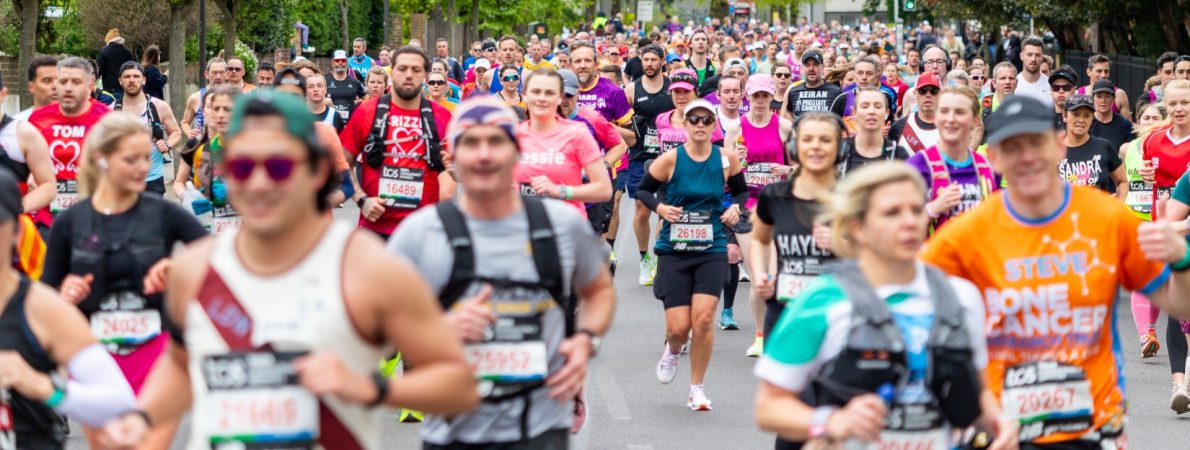
For blind and partially sighted runners, completing a marathon is about far more than crossing the finish line. It involves working closely with a guide, navigating unfamiliar environments, and adapting to challenges along the way. At Thomas Pocklington Trust (TPT), five staff members have taken on this challenge. They each have their own story of determination, skill and achievement, showing that marathon running is there for the taking.
In this article, TPT Stakeholder Engagement Intern and marathon runner Deepika Nallathambi, uncovers the challenges and motivations behind each of their journeys. She writes:
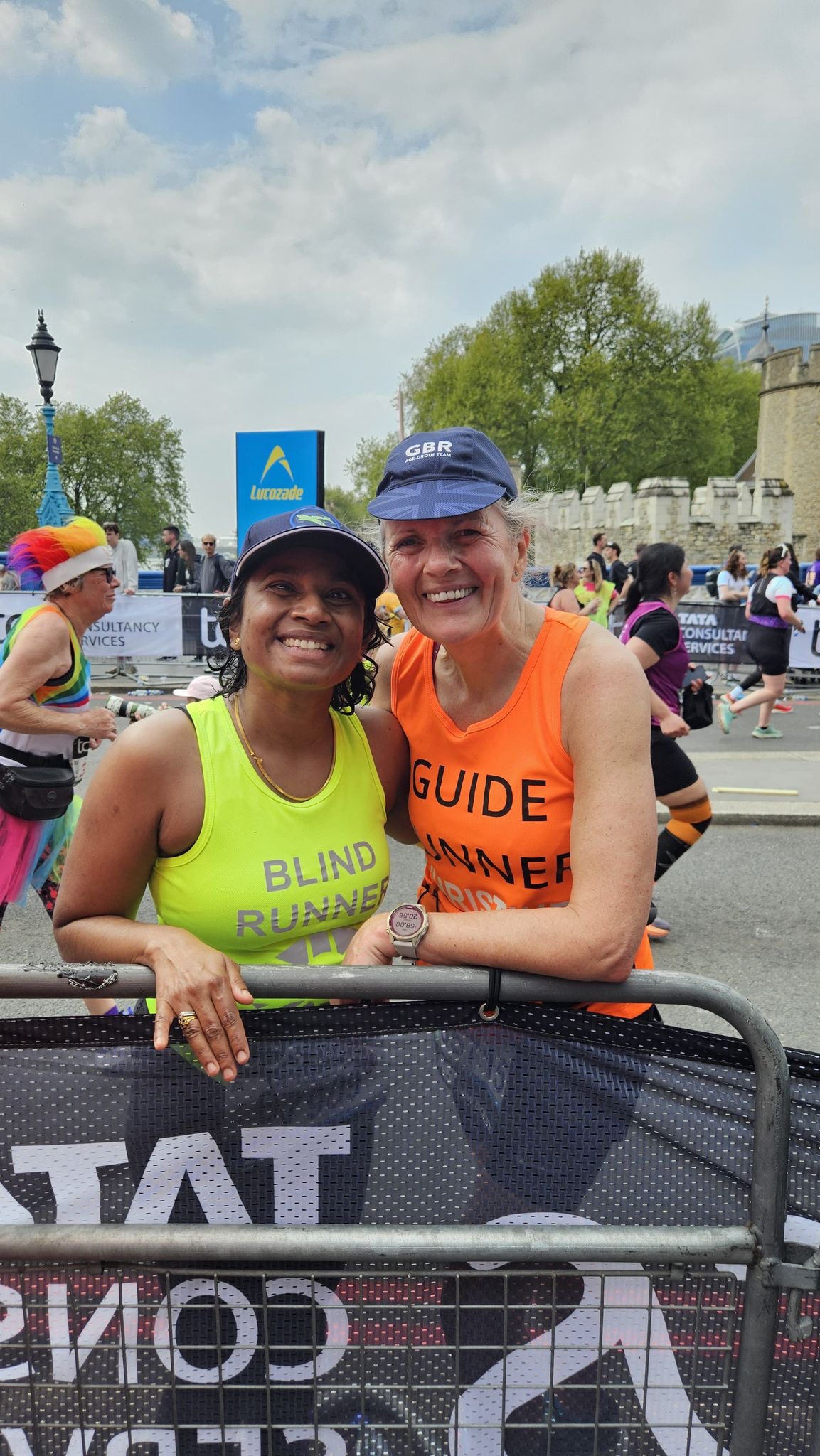
I ran the London Marathon in 2025 tethered to my guide runner, Christine Broughan. While researching for this story, I came to know that in addition to me, TPT had four other marathon runners among its staff: Kelly Barton, Yahya Pandor, Joshua Feehan and Gareth Dawson.
Along with my lived experience, this story has been enriched by interviews with all four of them, as well as my guide runner, Christine. An analysis of these interviews brings to light a compelling and consistent narrative:
Running long-distance with limited or no sight is not merely an athletic achievement; it is a navigational, emotional, and logistical triumph. This story focuses on the challenges each of the marathoners had to overcome in order to reach that moment of triumph.
One of the common threads to emerge across all the interviews is that not all the runners initially felt running was for them. For example, before she became a fixture at park runs and an advocate for inclusive fitness for blind and partially sighted people, Kelly had little or no experience with fitness. She admitted:
“I didn’t even know blind people could run.”
Kelly was approaching forty and wanted to be fitter, and when she mentioned this to her GP, he suggested that she try park run. Serendipitously, he was a trained guide runner himself, and Kelly did her first park run guided by him. She walked-ran this in about forty-five minutes, an effort which left her feeling exhausted but hooked. Today, her personal best is 22.35 over five kilometres. She has run several marathons, including the London Marathon, which she will be running for the third time this year.
As for me, I just wanted to stay as fit as possible, and running was something I felt I could do wherever I was. I was not even thinking of park runs, let alone a marathon, when I initially moved into my student accommodation in 2022. I felt the car park in my accommodation was a safe and accessible spot to run, and a chance meeting with one of the pro vice-chancellors of the university turned my fitness journey on its head. She casually asked me why I was running in the car park while there was a gym at the university just across the road. I explained that the place where I needed to cross the road neither had a zebra crossing nor a pelican crossing, and therefore, was not safe. Next thing I know, the director of the sports facility was calling me and a structured personal training programme was designed specifically for me.
The staff from the fitness facility would pick me up for my sessions and bring me back as well. The pro vice-chancellor, who eventually guided me during the marathon, didn’t stop there. She contacted the volunteers at the nearest park run at Sunny Hill Park, and my park run love affair started in the summer of 2023. When the opportunity to run the 2025 London Marathon as a fundraising effort for the RNIB came along, I grabbed it with both hands. To my pleasant surprise, Christine, the pro vice-chancellor, agreed immediately when I asked if she would be my guide runner. Christine is a former member of Team GB for triathlon.
Josh’s first experience with a guide runner began inauspiciously. His first guide runner ran him into a pole. This might have put off a lot of people from running. Not so with Josh. He trains on the running track, and has run the Brighton Marathon in 2017. He isn’t stopping with running, and is planning to participate in more challenging events like Hyrox.
Yahya is aiming big! His aspiration is to qualify for the 2028 Paralympics in Los Angeles.
Gareth started running in childhood, and built natural stamina for long-distance running by playing football. However, his running became sporadic. When he ran the London Marathon in 2024, he did so after several years without structured training for long-distance running. In spite of this, he ran the marathon without assistance from a guide runner.
All the stories are different. Yet, a common question is bound to rise; how do you run when you can’t see? The answer, as can be understood from all the stories, is: willpower and determination will always ensure that one finds a way.
Finding a guide to run with is a huge challenge. The four TPT marathoners who run with guides agree that guide runners should possess certain essential qualities; namely, availability, reliability, willingness to sacrifice their Personal Best times for the runners they are guiding, ability to give clear, concise directions, a can-do mindset, which helps in navigating any kind of hazards and large crowds, and lastly, the ability to match the pace of the runner they are guiding. Trust is a very important factor.
Runner and guide runner should have a rapport and be able to trust each other. Availability of guides can sometimes prove challenging.
Kelly sums it up this way: out of the maybe 200 runners in her club, two or three may volunteer to guide. She says everyone should take turns guiding. After all, sight-loss can happen to anyone at any time. If it happened to them, would they not want someone to guide them so they can continue running?
Christine, my guide runner, says trust in each other and knowing your running partner is the most important part of the equation. Christine and I trained together only a few times before the 2025 London Marathon as we were living in different parts of the country. Yet, due to our friendship and rapport established over the last few years, we could communicate clearly and the guiding experience turned out well for both of us.
However, Christine says if I had been a total stranger, and she had been approached by the marathon organizers to guide me, she might not have done so. She says guiding has a specific set of challenges, namely, the guide has to pay attention to their surroundings at all times, which means guides cannot listen to music while guiding, guides must possess the ability to describe the surroundings, and they should also be able to provide encouragement when needed. Kelly and Yahya agree these are qualities their guides possess.
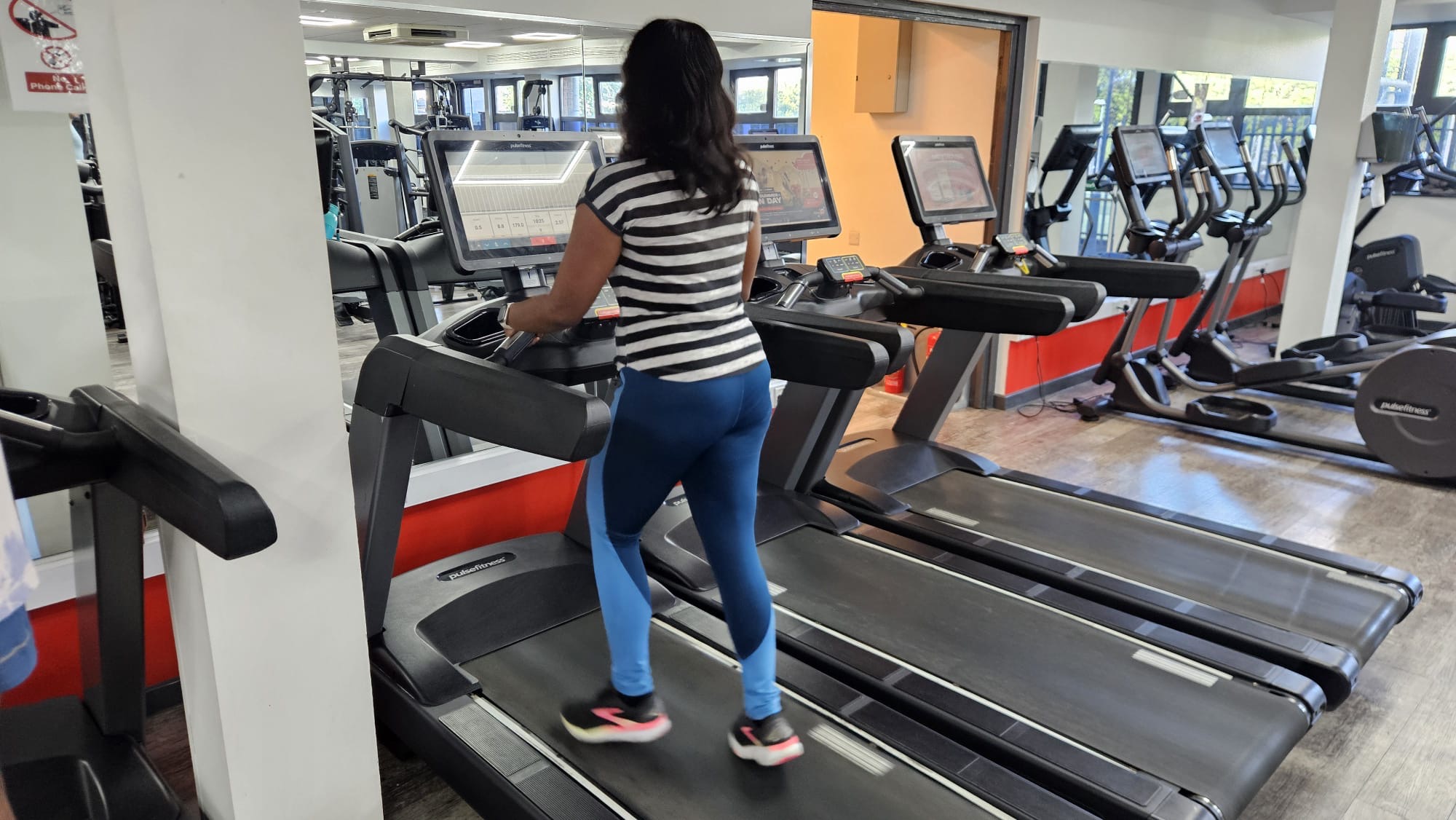
All the TPT marathoners featured in this story, with the exception of Josh, primarily trained on the treadmill before running a marathon. Josh says the treadmill is not safe for him, so he trains on a running track. Running on the treadmill can be boring, and sometimes, tedium can set in, but sometimes, it may be the only way. This is due to a variety of reasons:
Although running on the treadmill can be monotonous, boring and lacks stimulation, some runners say that it improved their mental resilience.
After deciding to run a marathon, finding the right guide and enduring long, tedious hours on the treadmill, D-Day finally arrives. But so do the accompanying challenges.
Gareth described arriving alone because his companions were delayed. Navigating the maze of people, volunteers, and different starting zones, each labelled with signage he couldn’t easily read, was deeply stressful.
He missed his assigned start window, though his timing chip ensured fairness once he crossed the line. Others described the anxiety of entering massive, chaotic spaces filled with noise, movement, and objects they couldn’t identify, which proved disconcerting.
Another factor to contend with on Race Day was the crowds. For runners like Yahya, who is sensitive to noise, the cheering crowds were exhausting. Yahya said he found it difficult to handle the constant noise stimulation; it was overstimulating, stressful, and made guiding harder. On the other hand, for runners like me and Gareth, the crowd lifted our spirits.
Gareth remembers hearing “Come on, Gareth!” dozens of times—only to discover much later that another runner ahead of him had the same name on his vest.
“It still motivated me,” he laughed.
The next challenge on Race Day is guide runner-specific. They have to constantly keep their eyes open for any stray water bottle that may be a trip hazard, packets of energy gel which can turn the floor slippery, and the crowds when they refuse to move. After mile 13, Christine stopped being polite and just started yelling, “blind runner passing through”.
The challenge which can undo every marathoner’s preparation is The Wall. I hit the Wall at mile 17 and required medical attention before walk-running the rest of the race to finish in 8 hours. When she ran the Berlin Marathon, Kelly had to walk-run the last six miles. She described those miles as “more a limp than a run”, and later discovered she had had COVID.
Yet, in spite of all these challenges, every runner featured in this story, including myself, felt exhilarated when we crossed the finish line.
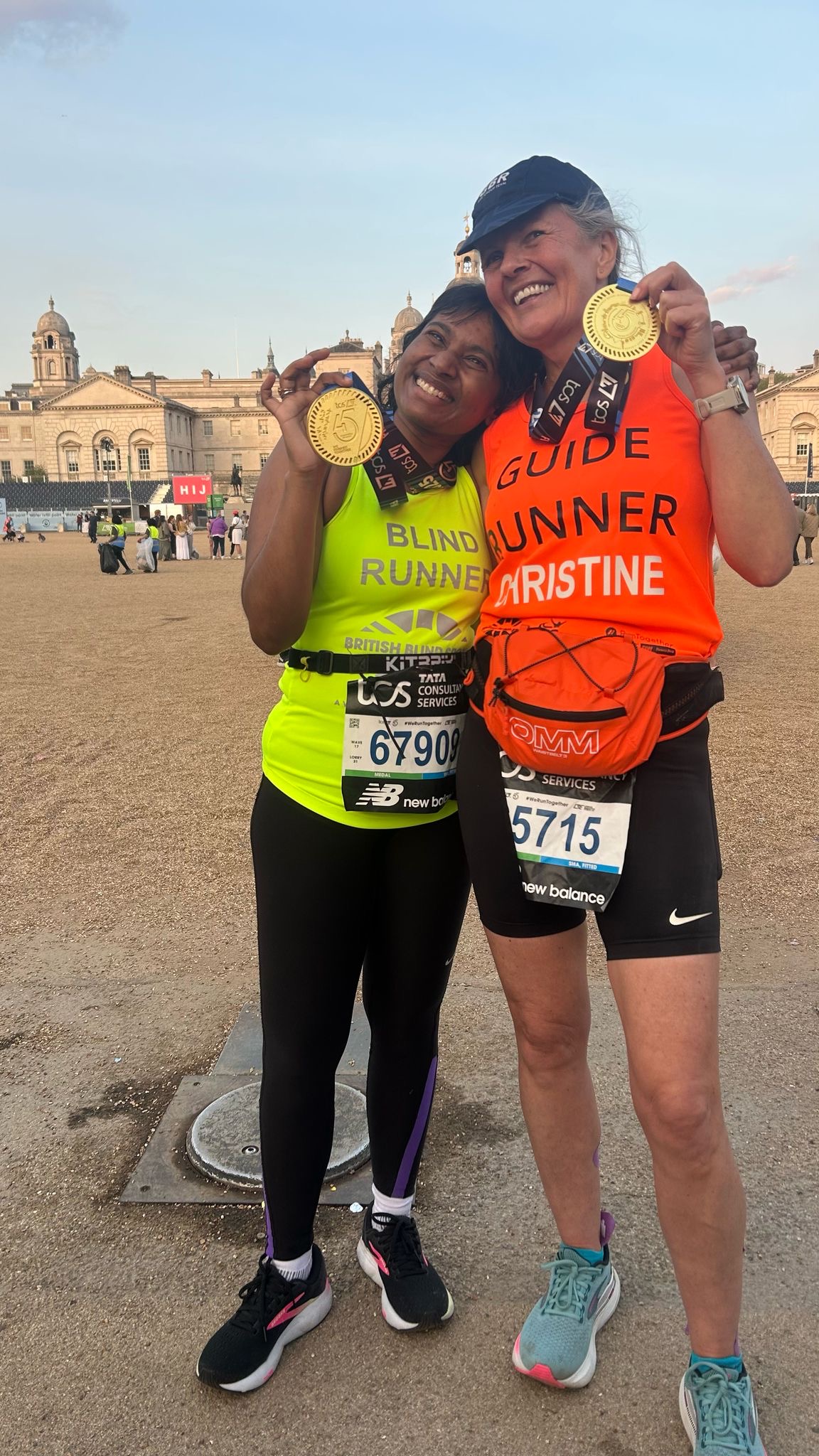
All the TPT marathoners agree that running gives them a sense of freedom and accomplishment. For me personally, it makes me feel unstoppable and invincible. Running a marathon is a test of both physical and mental resilience. Running without sight adds an extra layer of complexity to the existing challenges. Yet, overcoming them and crossing the finish line is one of the best feelings in the world. That is why we do it. Every marathoner interviewed has said they wish to do it again.
TPT marathoners would like to tell blind and partially sighted runners who are aspiring to run marathons in the future to start small with park runs and slowly build up the miles before deciding to run a marathon. As Yahya’s aspirations show, only the sky is the limit.
“Go for it!”