
Join our mailing list
Get the latest on our campaigns, news and events from Thomas Pocklington Trust by joining our mailing list
Date posted: 2nd October 2026
With driverless vehicles expected on London’s roads in the near future, Thomas Pocklington Trust (TPT) held its second roundtable discussion with Waymo to explore how the technology could affect blind and partially sighted (BPS) people.
TPT’s Chief Executive Officer (CEO) Charles Colquhoun and Policy and Campaigns Manager Bhavini Makwana opened the event, encouraging an open discussion to understand how automated transport could improve independence for BPS people, as well as any concerns about accessibility.
Around 70 blind and partially sighted people attended the event on 10 August, following on from the 40 who attended the first session held in January. Attendees spent more than an hour asking questions about potential accessibility challenges on London’s busy streets, accessing the vehicle safely, guide dog users’ ability to use the service, how to book a car and how to identify the car.
Participants heard from Waymo’s team about how the company is developing and operating autonomous vehicle services and its plans to launch in London this autumn.
Several features are designed to help blind and partially sighted passengers locate their vehicle, including the ability to remotely sound the horn. Users will also be able to book a car through Waymo’s app, like other private car hire services.
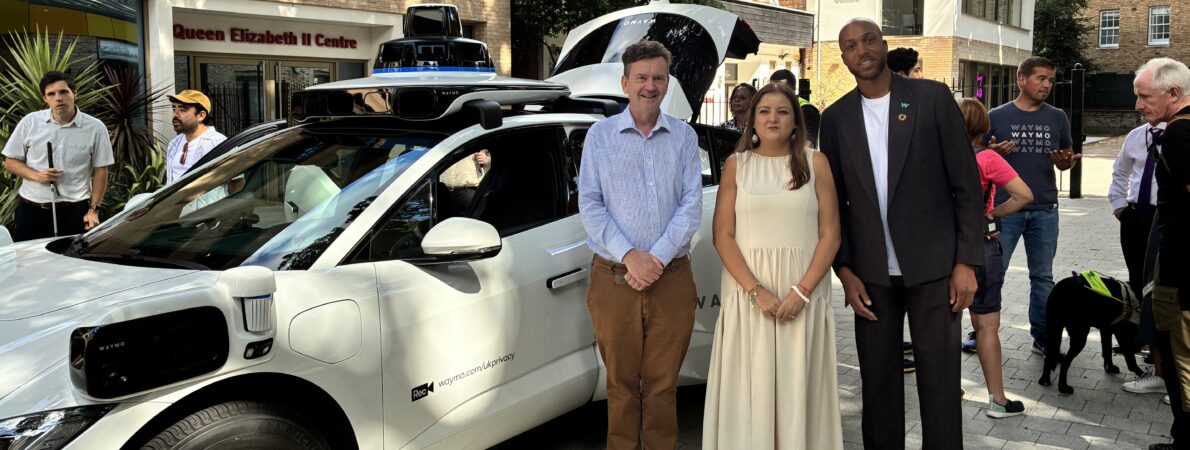
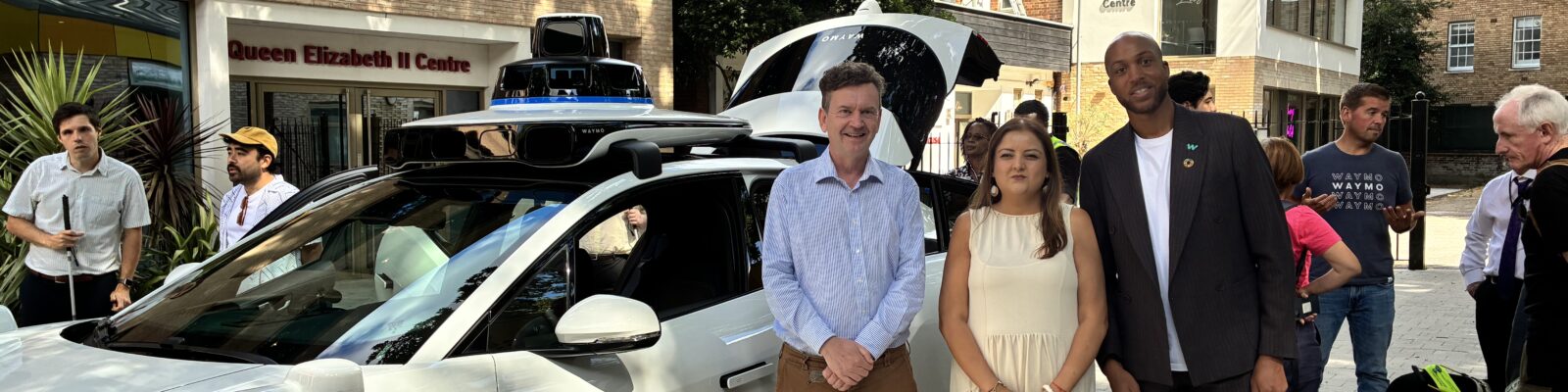
Following the session, attendees were able to check out one of Waymo’s driverless cars. They were able to sit in the back and the passenger seat to get a feeling for how it would be in the real world. The car is a white Jaguar with cameras on each side of the vehicle, at the back, and on the roof. The rooftop also has sophisticated lidar equipment to help the car map its surroundings.
TPT CEO Charles Colquhoun said:
“Events such as this are invaluable to TPT, the attendees and Waymo. Public and private transport are vital services to improving independence for BPS people. By getting everyone in a room and discussing real world experiences, we can help improve services such as Waymo’s for BPS across the UK.”
Waymo Head of Public Affairs Heather Aijian said:
“Autonomous vehicles have the potential to expand independence and access to mobility for blind and partially sighted people, but we cannot design those solutions in a vacuum. Our partnership with Thomas Pocklington Trust gives us an invaluable opportunity to listen directly to the people who could benefit from Waymo’s service and understand the barriers they experience today. That feedback helps us build a service that is safer, more inclusive and genuinely responsive to the communities we hope to serve and ultimately helps us design a better service for everyone.”
TPT Policy and Campaigns Manager Bhavini Makwana said:
“It is vital that blind and partially sighted people are at the heart of conversations about new ways of getting around. As autonomous vehicles become a reality, people need to have the opportunity to understand the technology, feel confident and safe using it, and know what to expect at every stage of their journey, from booking the vehicle to arriving at their destination.
“As someone with lived experience of having a vision impairment, I understand both the excitement and the nervousness that can come with a new way of travelling. That is why it was such a pleasure to organise this event and bring together more than 70 blind and partially sighted people to learn, ask questions, share their experiences and have their voices heard. Their needs, experiences and perspectives must remain central as autonomous vehicles develop and become part of our everyday lives.”
The event forms part of Thomas Pocklington Trust’s wider transport campaigning work, which calls for inclusive design, accessible booking systems and greater accountability across all forms of transport.
To learn more visit: Transport – Thomas Pocklington Trust