

Join our mailing list
Get the latest on our campaigns, news and events from Thomas Pocklington Trust by joining our mailing list

Date posted: 8th January 2026
After more than five years of waiting, today’s Government response on pavement parking falls short of the decisive action that blind and partially sighted people, disabled people and campaigners have long called for.
Rather than introducing a clear national ban on pavement parking, the Government has chosen to devolve powers to local authorities and mayors. While this approach may appear positive on paper, the consultation evidence itself highlights serious concerns around inconsistent, under‑resourced enforcement and the risk that pavement parking will continue to be treated as a low priority.
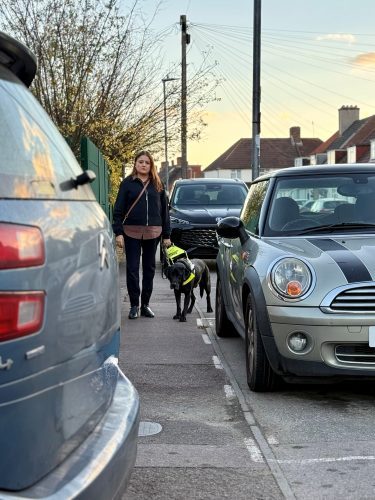
For blind and partially sighted people, pavement parking is not an inconvenience, it is a daily safety risk. Vehicles blocking pavements force people into the road, restrict independence, and prevent safe access to local communities. A system that relies on local discretion does not provide the certainty, consistency or protection that people with sight loss need.
Bhavini Makwana, Policy and Campaigns Manager and Guide Dog user states:
“Pavement parking has turned simple, everyday journeys into moments of fear and anxiety for me.
When a car blocks the pavement fully or even partially my Guide Dog and I are forced into the road just to continue our journey. That puts us in immediate danger, not because we’ve done anything wrong, but because someone chose convenience over consideration.
This isn’t a rare occurrence. It happens almost daily, vehicles spilling out of driveways, delivery vans unloading onto pavements, drivers blocking crossing points with no thought for others. Each time, we’re left vulnerable.
Yesterday’s response places responsibility on Local Authorities to enforce existing powers if they choose to prioritise keeping pavements clear. That uncertainty means every time I step outside, I’m left wondering what dangers lie ahead.
This is why a national ban on pavement parking is essential. Not optional. Not dependent on postcode priorities. A ban that protects the safety, dignity, and independence of blind and partially sighted people and our Guide Dogs everywhere. Accessible streets are not a luxury. They are a right.”
We have campaigned against pavement parking for years, alongside disabled people and allies across the country. This response does not resolve the problem, and it does not mark the end of our campaigning. Our position remains unchanged. We continue to call for a national pavement parking ban, with exemptions clearly set out in law, so that pavements are safe and accessible everywhere, not just where enforcement happens to be prioritised.
We will continue to challenge the Government to go further and work with both national and local decision‑makers to ensure the work continues. Until blind and partially sighted people can travel independently and safely on the pavement, this issue is not resolved.
You can read the full government response to the Pavement Parking Consultation here